Although my wife and I have published ebooks before, after going to several SF Conventions the last 3 years, I decided I should also publish my first novel in paperback—maybe even hardback and audio eventually. When I did, mysterious things happened.
I published Advance Guards on Amazon, the big boy in indie publishing because, well because they generate the most sales for authors I know who are on multiple platforms. Now that I have the book in a paperback format, I can buy copies at a discount (because I get no royalties for doing that), so I can autograph them and sell them to people I meet in person. (Oh noes, there’s going to be sales tax! Oh the unending labors of an independent author!) So today I used my preferred search engine, Duckduckgo, to search for “Advance Guards” “Frank Hood”. (There are many reasons for my doing that, but I’ll leave that at the end of this essay, so you can skip it.)
I was surprised to see the first result was from Barnes & Noble. Not that I’d knock that, but how did that happen? Intrigued at how they would make money off a book I published on Amazon, I put it in my shopping cart and saw the answer. B&N charges the same cover price but $6.99 for shipping and handling. Now I have Amazon Prime, so buying my book at full price for myself would be free shipping, but it’s clear that B&N is taking their profit out of that $6.99 shipping charge.
The next result was for some Australian website called Reading Books where they charged the equivalent of $24.25 plus $2.20 for “GST”. I have no idea if that’s sales tax, import tariff, or shipping and handling. Amazon claims my paperback is not officially released in Australia, but I found it on Amazon.au (Amazon’s Australian site) for $13.79 (including the “GST”). In the UK, where Amazon claims my paperback is officially released, the price is $10.79 (including VAT!). So grab it while you can you lucky Northern Irish, Welsh, Scots, and Brits! The next link is to eBay where it’s selling for $16.69. But WAIT! There’s one more before we get to Amazon. That is some place I’ve never heard of calling itself scifier.com. They claim to be selling it for $12.84, discounted from $13.02. It boggles the mind, but I know all you savvy shoppers out there will go to the horse’s mouth to get the best price, right?
Now we come to the &.
Duckduckgo offered something called “Search Assistant” on the right column. I was curious of course, so I asked for “more” and was presented with this:
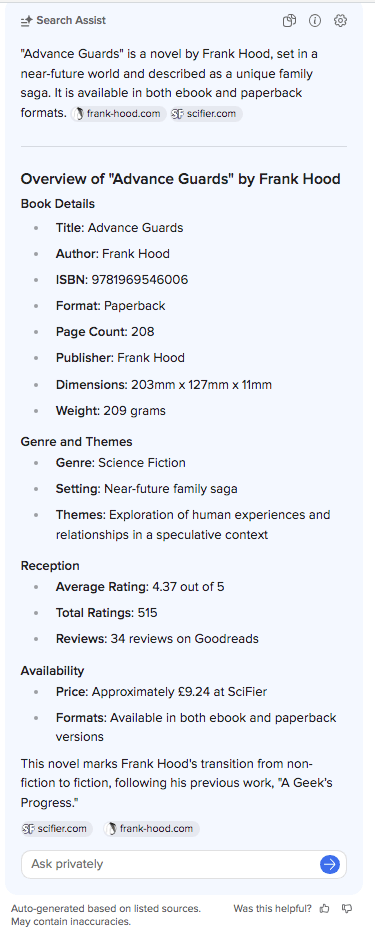
Now most of that is accurate, including, astonishingly, the last sentence that notes the departure into fiction from my earlier ebook of non-fiction. Stunningly however, AI has awarded me with 515 ratings (and pretty good ones) and 34 reviews on Goodreads, where Advance Guards is attributed to a different author who happens to share my name, and it has zero reviews.
What can I conclude with but a corruption of a Chinatown quote, “Forget it Jake, it’s book selling.”
Oh yeah, for you diehards who really want to know why I would use a search engine for my own book. You remember I mentioned that, don’t you? Well, it seems Amazon loves to give out different URLs (that’s hyperlinks to non-techies) for books depending on how you arrived at the page. So if you find it via Amazon’s internal search, the URL is dozens and dozens of gibberish characters long. If you found it via an outside search engine, the URL seems perfectly understandable. Of course I’ve created my own tinyUrl that I find much more convenient to cite.
 Musings of a Restless Mind