A while ago I suggested somewhat whimsically that I should write up what an aspiring writer’s life was like a half-century ago. In 1967, at 16 years old, I told my father I wanted to be a writer. He came back with a statistic that only 150 Americans make their living solely by freelance writing. My 16 year old brain thought, “Cool I’ll be part of a real elite.” Did he offer me any advice or alternatives? No, but that was typical for me. It may seem rude or ungrateful of me because I was fed and clothed and never abused, but to say I was raised by wolves is an insult to the parenting skills of wolves.
I was raised from ages 10 to 18 on a ranch in the middle of nowhere, 10 miles from the nearest town that had a robust population of 19,000. There was no coterie of artists and writers like Hemingway’s Paris, or the Inklings of Oxford. There wasn’t even a Clifton’s cafeteria like LA had where a young Ray Bradbury, Ray Harryhausen, and other wannabe writers and fans could hang out with Forry Ackerman and have an occasional visit from Robert Heinlein.
In my high school graduating class of about 500, I was the only one who had any ambition to become a writer. Yes, we had a few who became lawyers or engineers, but that was it. Most of us went on to more menial and less prestigious careers. I didn’t have the means or gumption to move to New York like Bob Dylan or even L.A. and try to attach myself to people who knew what they were doing or even people who would support each other in trying. I did do what was expected of the son of an aerospace engineer and went to college—at UC Riverside. The campus had grown from the famed Citrus Station where diseases of lemons, oranges, and avocados were studied. UCR had a campus of 5,000 undergraduates and a world-renowned agriculture department. At the time Riverside was perhaps best known as the final resting place of the L.A. basin’s smog. On late Spring or summer afternoons, you could watch the tide of vile, impenetrable smog flow unflinchingly towards you on the sea breeze until it swallowed you and bumped to a halt up against the Box Springs mountains to stifle your breathing.
Despite my literary ambitions, I majored in history because I didn’t want to take Chaucer and, at 18, I wanted to learn something worth writing about. Did that work? Not the way I planned it to, but I did learn some things about how to think, research, and reason. For that I will always be grateful. I also took advantage of UCR’s newly formed Creative Writing department to write and get critiques on a dozen stories that I produced on blue mimeograph paper for distribution to the rest of the class.
So how does a hick from the sticks with a freshly printed BA in History in 1973 become a writer? I clung to whatever fragile reeds I could. First, there was a magazine called Writer’s Digest with articles from established writers about how to improve your writing and how to get published. They had a large, annual companion book called Writer’s Market that listed every magazine or publishing house open to unsolicited submissions. You started with closely reading a magazine’s submission guidelines from Writer’s Market and sending your story off with an enclosed Self-Addressed, Stamped Envelope (SASE as we said in the biz), so the magazine could send back your story with the pre-printed rejection notice.
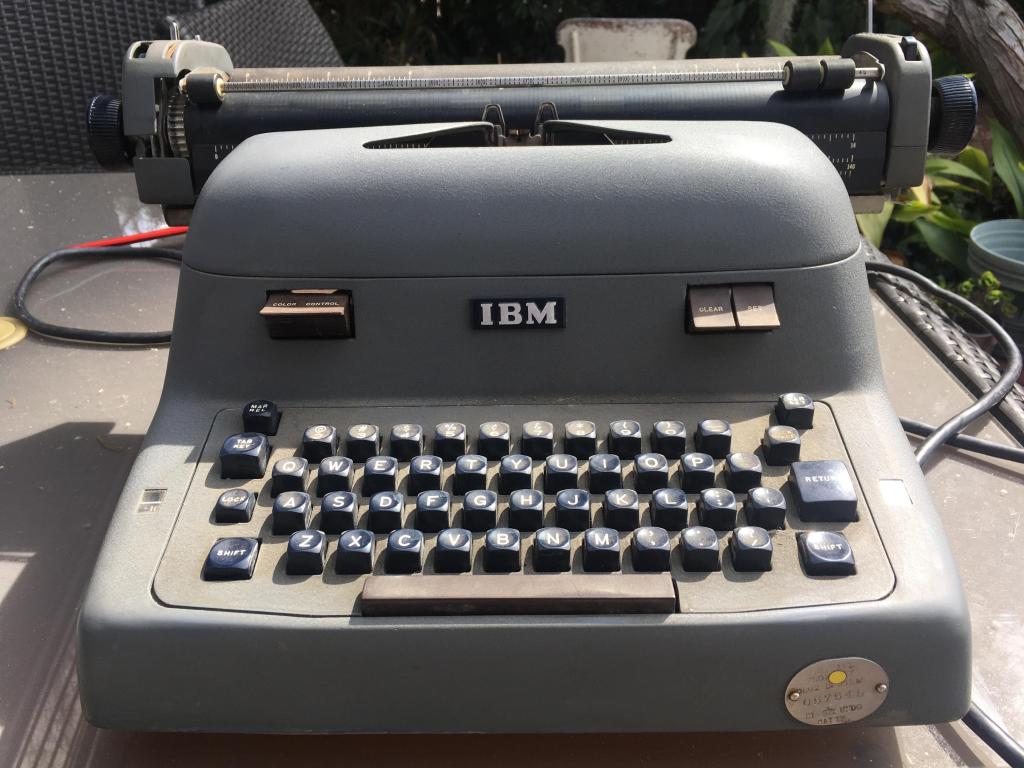
Did I mention that the tool above was what we used to produce our manuscripts? No backspace. No spell-check. No grammar-check. Absolutely no cut and paste. Typos meant either start over or scratch out the mistake with a ballpoint pen, making the manuscript look unprofessional. If you wanted to revise your story, you started over. And what was the prize at the end of the rainbow if some editor should deign your hard work worthy of publication? A promised payment of half-cent/word to (Wow bigtime!) 3 cents/word ($90 for a 3,000 word story) paid on publication which was typically a year later.
Playboy and Penthouse paid big money ($1,000/story), but that was only to established authors who took the easy payday to enhance the illusion that purchasers bought the magazine for the articles. Oh, did I mention that many publications insisted on buying “all rights” meaning they owned your story outright, and you could never make any other money off that story. Ask Jerry Siegel about that one. You got your hundred bucks, Sucker. We own Superman now. Talk about supervillains!
Also, since, with my job of sweeping the floors in a clothing factory, I made just enough to pay the rent, eat from cans of stew, and, if I shepherded my money well enough, a restaurant-bought pizza on Friday night to last me through the weekend. That meant I took advantage of the highly discounted “book rate” from the postal service that took about 10 days instead of 3 to cross the country each way, while I waited eagerly for the news from the magazine that “promised” a “typical” response in about 3 or 4 months. Most magazines forbade simultaneous submissions, that is submitting the same story to multiple magazines at the same time, but it was a rule more honored in the breech than the observance as another writer once said. If you were submitting to one magazine at a time and waiting 3 months or more for a reply, you would be old and gray before you reached the end of the list with even a single story.
Despite the lack of peers and mentors in San Diego, there were a few other ways to learn. There was the writers’ group consisting of middle-aged to older women who wrote romances and the occasional mystery. They were kind and helpful, but my SF stories didn’t seem to fit in. Also local colleges would occasionally pay for Rod Serling or Ray Bradbury to come down from L.A. to San Diego to lecture. Also there were the nascent SF conventions. I went to a couple of early Comic-Cons, but managed to not meet any of the authors. I also drove my 60 Chevy Bel-Air to Tuscon in 1976 for Tuscon IV at the Sands roadside motel. I was too broke to stay there and instead bunked with my cousins who lived in Tucson and drove to the Con each day. There I got to talk with Ted Sturgeon since there were only 120 of us.
It may have been there that I learned about a week-long writers’ workshop in Port Townsend at the Northeast end of the Olympic Peninsula at the entrance to Puget Sound. That was coming up the next year and featured Frank Herbert, Jack Vance, Ben Bova and other notable names in SF. I scrimped together enough money to pay for that and a train ticket to Seattle and a bus ride to Port Townsend, again staying overnight with a friend who had moved up to Seattle. Perhaps you’re sensing a theme here about a broke, itinerant, would-be writer. That was the life of a writer back then.
In any case some encouraging words from Frank Herbert and Ben Bova who was now sending me personalized rejection letters with my submissions to Analog did a lot to encourage me. I made some bucks writing book reviews for a new national SF magazine and sold my first story soon after coming home from that workshop.
I don’t know if I ever could have eventually scratched out a living as a writer in the 70’s, but my career was derailed by my reactionary, traditional views on morality, which were, even then, anathema to the New York cognoscenti who controlled the publishing world. If any of you have been bored with my stories of walking to school in the snow, uphill both ways, blame B. Durbin of Hoyt’s Huns who encouraged me to do this.


Leave a comment